
Exarcheia, Athens: A Straight Guide to the Anarchist Neighbourhood
What Exarcheia actually is — the politics, the street art, whether it's safe to visit, and where to eat and drink in Athens' most misunderstood neighbourhood.
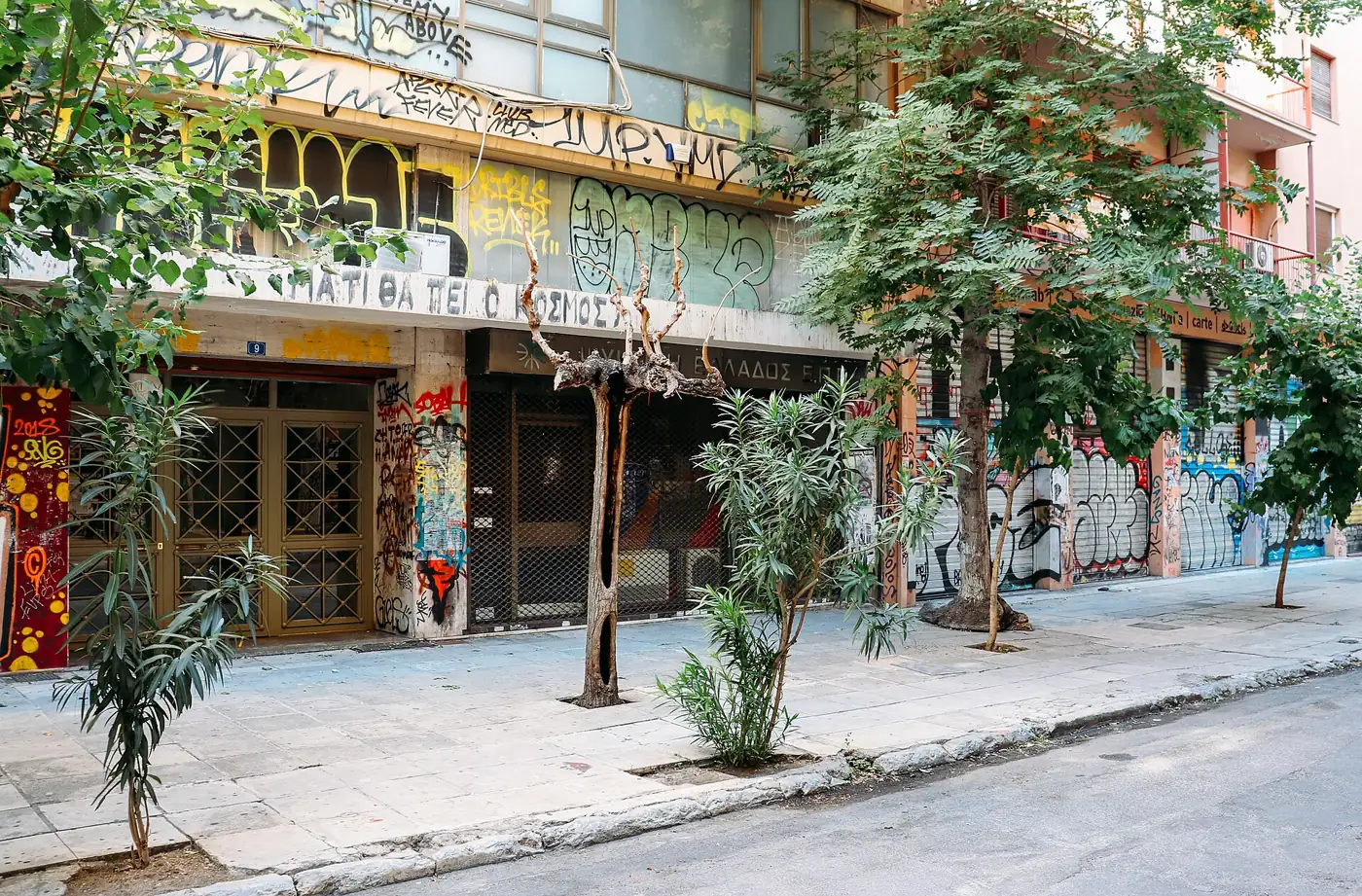
Photo: Stolbovsky, CC BY-SA 3.0
For the neighbourhood most visitors pair Exarcheia against, see Monastiraki and Psirri. For a wider sense of Athens after dark, the Athens nightlife guide covers the city's other scenes.
What Exarcheia Actually Is
Exarcheia sits just north of the centre, wedged between Kolonaki and Omonia and a short walk from the National Archaeological Museum. It gets described in two completely different ways depending on the source: international press coverage that leans on "anarchist stronghold" and "no-go zone" framing, and a quieter reality of bookshops, family-run tavernas, a large student population from the nearby Athens Polytechnic, and some of the best street art in Europe.
Both descriptions contain some truth. Neither is the whole picture.
Where the politics actually comes from
Exarcheia's identity is not a marketing angle — it comes from a specific history. In November 1973, students at the Athens Polytechnic, on the edge of the neighbourhood, occupied the campus in protest against Greece's military junta. The regime sent in tanks; the crackdown killed protesters and became a defining moment in modern Greek political memory, still marked every November with a march that starts near the Polytechnic.
Since then, Exarcheia has functioned as an informal home for anarchist, anti-fascist and left-wing activist groups, along with the artists, academics and students who share the neighbourhood with them. Squats, political murals and the occasional demonstration are a real part of the area's texture — not a performance for visitors, and not something staged for tourism.
Is Exarcheia safe to visit?
For a daytime walk or an evening at a taverna or bar: yes, in the way any dense, characterful city neighbourhood is generally safe with ordinary precautions. Locals treat it as a normal place to live, eat and study, not as a hazard zone.
Two things are worth knowing honestly rather than glossing over:
- Clashes between protesters and police do happen, usually tied to specific dates (the November Polytechnic anniversary) or specific flashpoints, and they can involve tear gas and road closures with little warning. This is uncommon on an average visit but not impossible.
- The area has periodically been the site of police operations and heightened tension around squats and demonstrations. If you see a large gathering, riot police, or a heavy uniformed presence, the ordinary tourist move is the same as anywhere else: leave the immediate area rather than watching.
Outside of those specific situations, the practical experience for most visitors is a slightly rough-edged, very authentic Athens neighbourhood — closer to "unpolished" than "unsafe."
The street art
Exarcheia is where Athens' street-art reputation started, before Psirri's murals became a tourist circuit of their own. The walls here carry political statements as often as pure aesthetics — anti-fascist slogans, portraits, tributes to specific events — layered and repainted over years, so what you see genuinely changes over time. There isn't a fixed "top five murals" list worth publishing, because the walls turn over; wandering the streets around Exarcheia Square and the blocks toward the Polytechnic is the actual way to see it, camera ready, on foot, at a slow pace.
Eating and drinking in Exarcheia
The neighbourhood's food and bar scene skews toward small, independent, unpretentious places rather than anything built for tour groups.
- The Black Salami Microbakery — a small bakery-café built around real sourdough and simple, well-made food, the kind of place that signals the neighbourhood's younger, creative resident base rather than its political reputation.
- Bar Ideal — a long-running, unpretentious Exarcheia bar, more about the crowd and the conversation than a design concept.
- Astron Bar — part of the neighbourhood's slightly more polished end, useful if you want a good drink without hunting through fully unmarked doorways.
Practical notes
- Getting there. Exarcheia is walkable from Omonia metro station (Lines 1 and 2), or roughly a 15–20 minute walk from Syntagma. There's no dedicated Exarcheia metro stop.
- When to go. Daytime for the street art and a calmer read of the neighbourhood; evening for the bar scene, which runs later and more casually than central Athens.
- What to skip. The main November anniversary period (around the 17th) can bring marches and a heavier police presence — worth knowing if your visit lands on those dates, not a reason to avoid the neighbourhood the rest of the year.
- How to behave. As with any residential neighbourhood with a strong local identity, treat it as somewhere people actually live rather than an attraction built for visitors — that alone accounts for most of the difference between a good and an awkward visit.
Frequently asked questions
Is Exarcheia dangerous for tourists?
For an ordinary daytime or evening visit, no more than any dense city neighbourhood with basic precautions. Real flashpoints exist around specific protest dates and police operations, which are uncommon but worth being aware of, not a daily risk.
Why is Exarcheia called the anarchist neighbourhood?
The reputation traces to the 1973 Athens Polytechnic uprising against Greece's military junta, after which the area became an informal centre for anarchist, anti-fascist and left-wing activist groups, alongside its student and artist population.
What is there to actually do in Exarcheia?
Walk the streets around Exarcheia Square and toward the Polytechnic for the street art, eat at one of the small independent tavernas or bakeries, and spend an evening at a neighbourhood bar. It rewards slow wandering more than a checklist.
How do I get to Exarcheia from central Athens?
Walk roughly 15–20 minutes from Syntagma, or take Metro Line 1 or 2 to Omonia and walk from there. There is no metro station inside Exarcheia itself.
Is Exarcheia worth visiting if I only have a few days in Athens?
If you want to see a side of the city beyond the Acropolis-and-Plaka circuit — real street art, a genuine student and activist neighbourhood, unpolished but not unsafe — yes, an afternoon or evening is enough to get a real feel for it.
Follow along
More Athens, beyond the page
Daily places, views and ideas for your next visit.