
Athens Areas Explained: Where to Stay for Your First Visit
Athens areas and neighborhoods explained for a first trip: compare sightseeing, food, nightlife, families, views, Metro access, atmosphere, price, and airport connections.
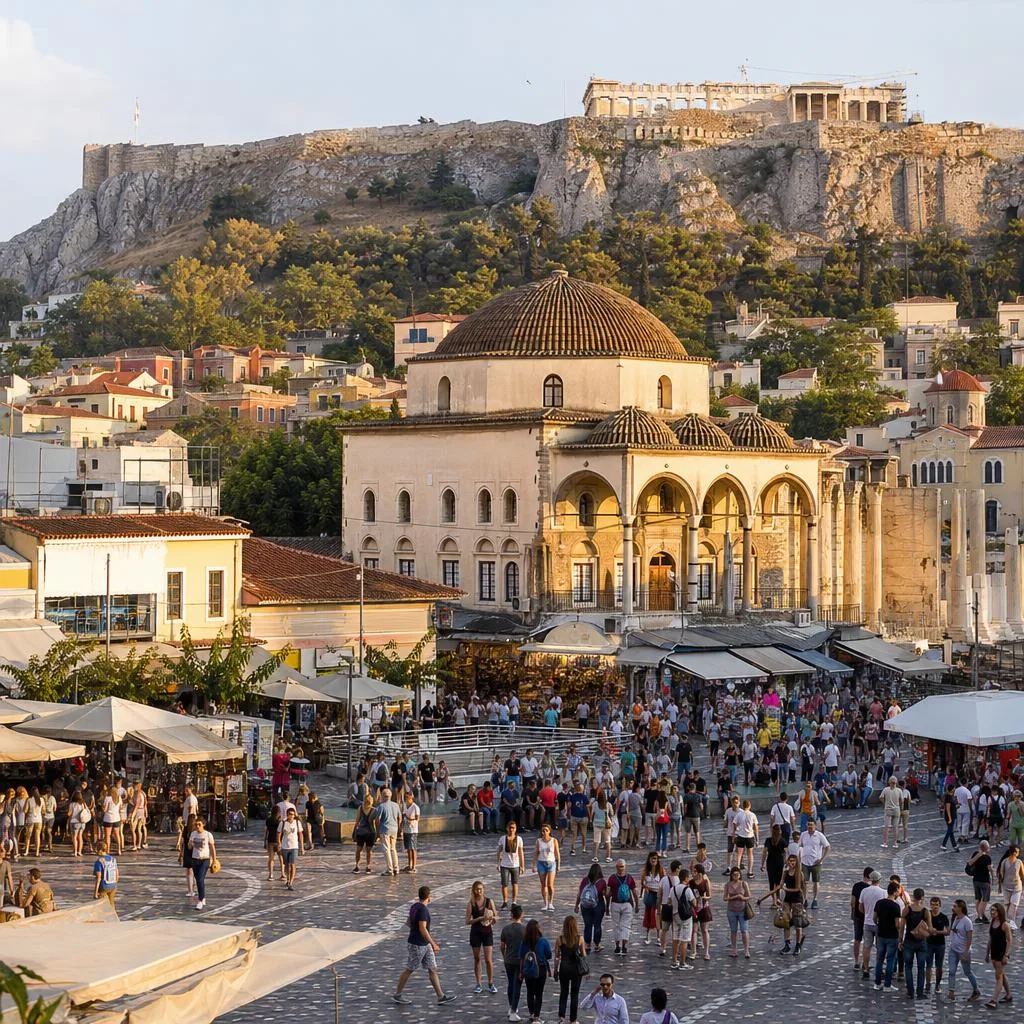
Athens areas explained: where should a first-time visitor stay?
For most first visits, choose a central area within an easy walk of the Acropolis, Plaka, Monastiraki or Syntagma. Athens is not difficult to cross, but a well-chosen base makes early starts, late dinners, museum visits and an airport connection much less tiring.
There is no single best neighborhood for everyone. Monastiraki is the strongest all-rounder for a short sightseeing trip; Koukaki is calmer and closest to the Acropolis; Plaka is the most atmospheric; Syntagma has the clearest transport connections; Psirri is best for food and nightlife; Kolonaki suits museums and polished evenings; Pangrati feels more residential. Use the Athens public transport guide alongside this comparison.
Think of “where to stay in Athens” as a choice between evening rhythms. Your hotel does not need to sit beside every monument: it needs to make your mornings, meals and return journey easy.
Best areas at a glance
| Area | Best for | Trade-off |
|---|---|---|
| Monastiraki | First-time convenience, food, airport Metro | Busy and lively late |
| Koukaki | Acropolis access, local feel, quieter nights | Fewer major transport connections |
| Plaka | Atmosphere, couples, historic lanes | Touristier and often pricier |
| Syntagma | Transport, hotels, short stays | More civic and commercial |
| Psirri | Restaurants, bars, creative city life | Noise and a less polished feel |
| Kolonaki | Museums, shopping, upscale stays | Expensive and uphill in places |
| Pangrati | Local restaurants and wine bars | Less convenient for the first Acropolis start |
Which Athens area fits your travel style?
- Best for first-time sightseeing: Monastiraki gives you the most central all-round base; Koukaki is better if the Acropolis is your clear priority; Plaka is best when historic atmosphere matters more than a quiet street.
- Best for food: Psirri and Monastiraki put markets, souvlaki, tavernas and independent restaurants close to your door. Start with the Athens food guide and the Psirri and Monastiraki guide.
- Best for nightlife: Psirri is the most convenient base for late dinners, bars and street art; Monastiraki works for rooftops and a wider choice of evening walks. The Athens nightlife guide explains how the different clusters feel.
- Best for families: Koukaki is a useful compromise between the Acropolis, the museum, cafes and a more residential pace. Syntagma is practical for families who value simple Metro and bus connections. Check the exact hotel street, lift and route rather than choosing from a neighborhood label alone.
- Best for views: Plaka, Koukaki and Monastiraki have the strongest chance of an Acropolis-facing walk or rooftop. A room advertised with an “Acropolis view” can mean a private balcony, shared roof or distant angle, so verify the property itself.
- Best for Metro and airport connections: Syntagma and Monastiraki are the simplest central bases for the Metro; Syntagma is particularly practical for early departures, while Monastiraki connects the airport route with the old centre on the right service.
- Best for a quieter stay: Koukaki, Pangrati and selected streets in Kolonaki feel less dominated by the main tourist flow. “Quiet” is building- and street-specific, so read recent reviews and ask about windows.
- Best for museums and an upscale stay: Kolonaki puts galleries, shopping and the Museum of Cycladic Art within a more polished evening setting. It costs more and some walks are uphill.
The Athens neighborhoods directory is useful when you want to explore the areas visually. Use the Acropolis guide, the Acropolis entrances guide and the Athens museums guide to see how much of your day will actually happen near each base.
Monastiraki — the best all-round base
Choose Monastiraki if you want to step out into food, markets and ancient Athens. The square, flea market, Ancient Agora and Psirri are all close, and Line 3 makes the airport connection straightforward on the right service.
The downside is energy: Monastiraki is busy, especially around the square, and some streets stay loud late. Check the exact street and window quality before booking. For food, views and a neighborhood route, use the Psirri and Monastiraki guide.
Best for: two- or three-day trips, first-time visitors who want to walk everywhere, travelers who want the city outside their door.
Koukaki — the calmest Acropolis base
Koukaki sits just south of the Acropolis Museum and gives you one of the easiest early starts for the rock. It has cafes, bakeries, wine bars and a more residential rhythm than Plaka. The Acropolis Museum is close enough to visit without turning it into a major expedition.
Koukaki is a good compromise if you want the monuments nearby but do not want to sleep in the center of the nightlife. Some streets are uphill and the Metro coverage is less immediately useful than Monastiraki or Syntagma, so check the walk from your accommodation to the station.
Best for: couples, families, repeat visitors, early Acropolis starts, and anyone who prefers a neighborhood feel.
Plaka — the most atmospheric choice
Plaka is the postcard Athens of marble lanes, neoclassical facades, tavernas and views toward the Acropolis. It is wonderfully placed for wandering after dinner, and the National Garden and Syntagma are within reach.
Its atmosphere comes with tourist demand. Prices can be higher, the busiest streets can be noisy, and a restaurant-filled lane is not always the quietest place to sleep. Look for a side street rather than booking solely on the promise of an Acropolis view.
Best for: a romantic stay, visitors who prioritize atmosphere, and travelers who want the historic center immediately outside.
Syntagma — the practical transport hub
Syntagma is the easiest area for connections: the Metro, airport bus, Line 3 and many bus routes converge here. It is useful for a short stop, an early departure, or an itinerary that mixes the center with the coast and outer museums. You are also close to Parliament, the National Garden and the changing of the guards.
The feel is more civic and commercial than Koukaki or Plaka. Hotels can be excellent, but the square itself is not the most intimate Athens experience. Choose Syntagma for logistics and convenience, not because it is the prettiest neighborhood.
Best for: first and last nights, business travelers, families who value simple transport, and anyone with a very early airport departure.
Psirri — the food-and-nightlife base
Psirri is the right choice if your ideal Athens day ends with a long dinner, a bar and street art rather than an early night. It is central, close to Monastiraki and full of independent restaurants and late venues.
The trade-off is noise and texture. Psirri feels urban and lived-in, not polished; check reviews for street noise and avoid assuming that every central address feels the same after midnight. Start with the Athens food guide and the Athens nightlife guide to see whether its rhythm suits you.
Best for: food travelers, nightlife, younger travelers and visitors who like a creative, energetic base.
Kolonaki and Pangrati
Kolonaki is polished, museum-rich and close to Lycabettus Hill. It suits visitors who want galleries, good restaurants and a quieter upscale evening, but it is expensive and parts of it are steep.
Pangrati feels more local, with independent restaurants, cafes and wine bars around its squares. It is a good longer-stay choice, but first-time visitors should be comfortable using buses, taxis or longer walks for the Acropolis and Monastiraki.
How to choose for your trip length
For two days, pick Monastiraki, Koukaki, Plaka or Syntagma. Minimize transfers and keep the ancient centre walkable. The 2-day itinerary is built around those bases.
For three days, any central area works. Use the extra day for neighborhoods, museums or a short escape with the 3-day itinerary.
For four days or more, choose the atmosphere you actually want at night. The extra time makes Pangrati, Kolonaki or a quieter part of Koukaki more practical; see the 4-day Athens itinerary.
Booking checklist
- Check the walking route to the nearest Metro station, not just the neighborhood name.
- Read recent reviews for noise, lift access, air conditioning and luggage storage.
- Confirm whether an “Acropolis view” is from the room, a shared roof or a distant angle.
- Use a refundable rate if your flight and dates are not fixed.
- For airport timing, compare the airport-to-city options before choosing a very early departure.
The best first-visit base is the one that lets you return easily after a hot afternoon, reach your first booking without a taxi, and enjoy dinner without crossing the whole city.
FAQ
Is Monastiraki or Plaka better for a first visit?
Monastiraki is usually more practical for transport, food and airport access. Plaka is more atmospheric and romantic. Choose Monastiraki for convenience; choose Plaka when the historic setting matters more than a quiet, simple connection.
Is it safe to stay in central Athens?
Central Athens is widely visited and generally straightforward for travelers who use normal city precautions. Check your accommodation's exact street, keep valuables secure in crowded areas and ask the host about the immediate route at night.
Is Koukaki too far from the city centre?
No. Koukaki is close to the Acropolis and within walking distance of Plaka, Syntagma and the archaeological promenade. It feels quieter because it is more residential, not because it is remote.
Follow along
More Athens, beyond the page
Daily places, views and ideas for your next visit.