
Plaka, Athens: The Old Town Below the Acropolis, Explained
What Plaka actually is — its history, Anafiotika, the Byzantine churches, the tourist-trap tavernas worth skipping, and how to see Athens' oldest neighbourhood properly.
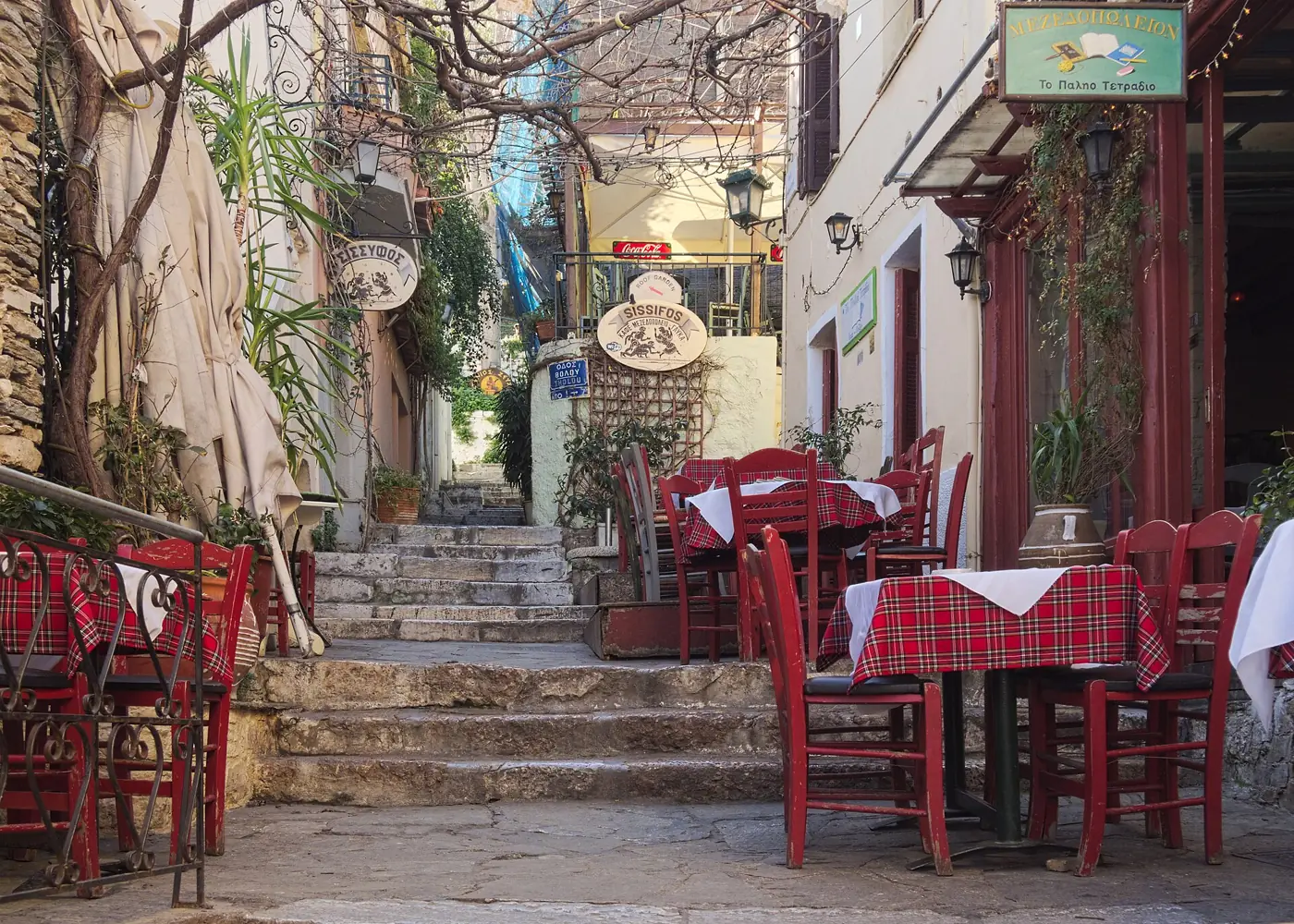
Photo: C messier, CC BY-SA 4.0
For the hidden village tucked into Plaka's north slope, see Anafiotika. For the neighbourhood immediately next door, see Monastiraki and Psirri.
What Plaka Actually Is
Plaka is the oldest continuously inhabited neighbourhood in Europe — people have lived on this ground, at the northeastern foot of the Acropolis, since antiquity. What you walk through today is mostly 19th-century: after Greek independence in 1832, the Ottoman-era quarter that stood here was rebuilt in the neoclassical style Athens adopted as its new national identity, which is why the lanes are lined with pastel two- and three-storey townhouses rather than anything older-looking. Underneath and around them, Roman-era ruins surface at odd corners — a column base here, an exposed wall there — because the whole district sits on top of ancient Athens.
The result is a small, steep, almost car-free tangle of marble-paved lanes between Syntagma, Monastiraki and the Acropolis's eastern slope. It is the most visited residential neighbourhood in the city, and it earns that status honestly: nowhere else in Athens packs this much history, architecture and atmosphere into a 20-minute walk.
A Short History
The name itself is contested — the most common explanation traces it to an Albanian word for "old," brought by Arvanite settlers who lived in the area under Ottoman rule, when Plaka was effectively Athens' only inhabited district (the rest of the ancient city lay in ruins or scattered farmland). After 1834, when Athens became the capital of the new Greek state, the city's population and construction exploded outward from here, but Plaka itself was largely spared heavy redevelopment — which is the accidental reason it still looks the way it does. A 1950s and 60s wave of nightclubs and bouzouki bars briefly turned parts of it rowdy and neon-lit; a 1980s municipal effort to pedestrianise the lanes and restore the neoclassical facades pushed the area back toward the quieter, walkable character it has today.
What to See and Do
Walk without a fixed plan first. Plaka rewards wandering more than any checklist — start at Mnisikleous or Adrianou Street and let the lanes pull you uphill toward the Acropolis.
Anafiotika, the whitewashed Cycladic-style micro-village built illegally into the rock by island workers in the 1840s, sits at the top of Plaka's climb — see the full Anafiotika guide for how to find the unmarked entrance.
The Lysicrates Monument, on a small square near the eastern edge of Plaka, is the only intact choragic monument left standing in Athens — a 4th-century-BC marble column erected to commemorate a theatrical competition's sponsor. Easy to miss, free to see, and almost always quiet.
The Roman Agora and Hadrian's Library sit right on Plaka's western border with Monastiraki — the forecourt of Hadrian's Library, with its hundred columns, gives a sense of Roman-era Athens the classical sites don't. Both are covered on the Acropolis combined ticket.
Plaka's small Byzantine churches — the neighbourhood holds dozens, several still in daily use. See the Orthodox church etiquette guide before stepping inside one.
The Tourist-Trap Tavernas, Honestly
Plaka has a real reputation problem, and it is mostly deserved on its busiest two or three pedestrian strips (Kydathinaion and the lanes immediately around it): aggressive touts pulling in passersby, laminated multilingual menus, and inflated prices for food that would be ordinary anywhere else in the city. This is the single most common complaint from visitors who've spent an evening here, and it's worth taking seriously rather than brushing off as unavoidable "tourist tax."
The fix is simple: walk one or two streets further from the main strips, toward the quieter lanes closer to Anafiotika or the Lysicrates Monument, and prices and pushiness both drop. A taverna with a tout stationed outside is a taverna to keep walking past, in Plaka more than almost anywhere else in the city.
Practical Notes
- Getting there. Plaka is walkable from Monastiraki (lines 1 and 3), Syntagma (lines 2 and 3) or Acropoli (line 2) — each station is a 5–10 minute walk from the edge of the neighbourhood.
- When to go. Early morning for quiet lanes and good light, especially around Anafiotika; evening for the restaurant and bar atmosphere, once the day-trip crowds have thinned.
- How much time to budget. An hour covers a decent walking loop; a relaxed half-day lets you add Anafiotika, a church, and a proper sit-down meal away from the main strips.
- Where to stay nearby. Plaka is one of several strong first-visit bases — see the where to stay in Athens guide for how it compares to Monastiraki, Koukaki and Syntagma.
FAQ
Is Plaka worth visiting, or is it too touristy?
Worth it. Plaka earns its popularity — the architecture and history are real, not staged — but the crowding and the tourist-trap tavernas are concentrated on two or three main strips. Stepping one street further in either direction solves most of the complaint.
Is Plaka safe to walk around at night?
Yes. It's one of the most walked, well-lit and consistently populated parts of central Athens after dark, popular with both visitors and Athenians out for dinner.
What's the difference between Plaka and Anafiotika?
Plaka is the wider old-town neighbourhood; Anafiotika is a small, distinct micro-village built into Plaka's upper slope by 19th-century island workers, with its own separate character, whitewashed houses and no restaurants or shops. See the Anafiotika guide for how the two fit together.
How do I avoid the tourist-trap restaurants in Plaka?
Avoid any taverna with a tout stationed outside trying to wave you in, and walk a street or two away from the busiest pedestrian strips like Kydathinaion. Prices and quality both improve quickly once you're off the main tourist line.
Follow along
More Athens, beyond the page
Daily places, views and ideas for your next visit.