
Anafiotika, Athens: The Hidden Cycladic Village on the Acropolis's Slope
How to find and visit Anafiotika — the whitewashed island village built into Plaka by Anafi islanders in the 1840s. History, directions, what to see, and how to visit respectfully.
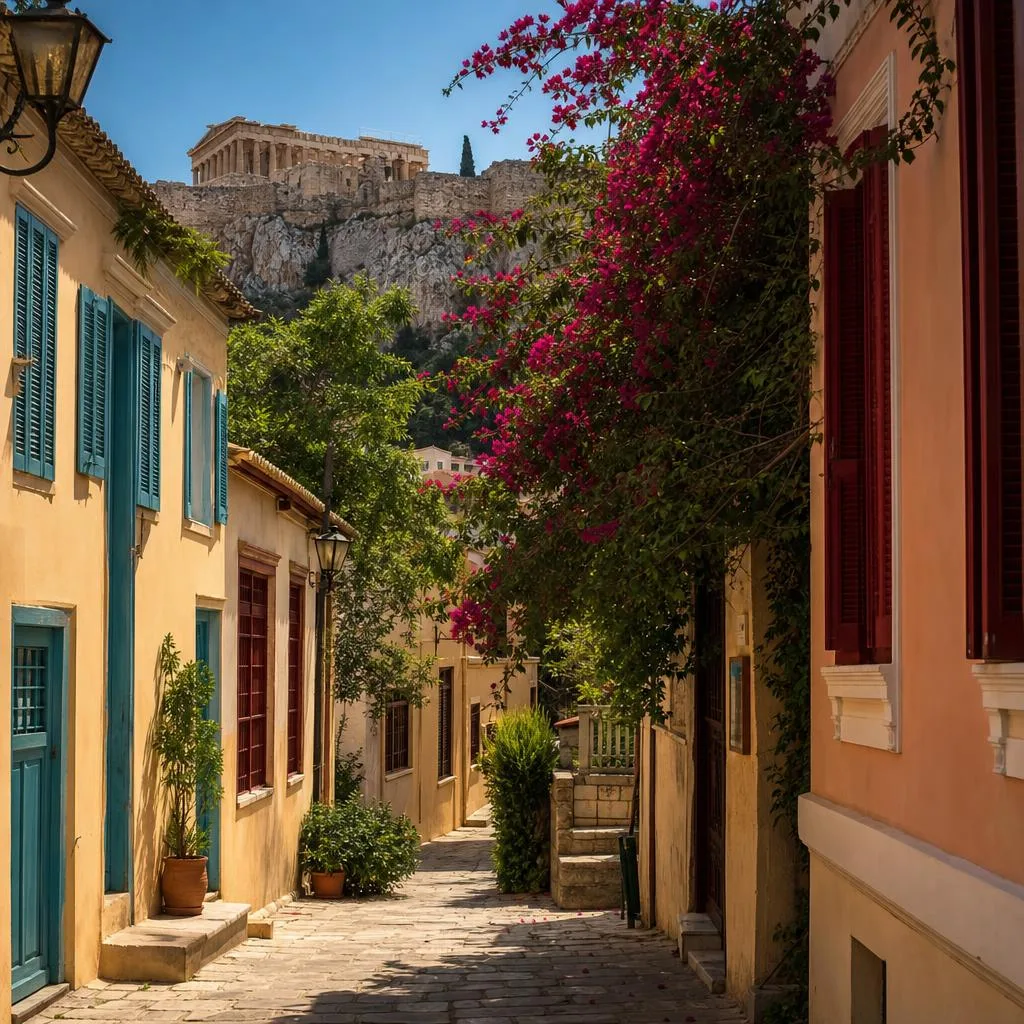
What is Anafiotika?
Anafiotika is a tiny whitewashed village tucked into the north slope of the Acropolis, inside Plaka — cube-shaped island houses, blue shutters, bougainvillea over narrow stone steps, all built by hand in the 1840s by construction workers from the Cycladic island of Anafi. It has no shops, no restaurants and no ticket booth. It is free to visit, open at all hours as a public set of streets, and it takes most visitors 20–30 minutes to walk through properly.
It is also, in the most literal sense, someone's neighbourhood: fewer than 50 of the original houses survive, and nearly all of them are still owned by descendants of the Anafi families who built them.
The island village built overnight
In the 1840s, after Greek independence, King Otto set about turning Athens into a modern capital, and skilled builders travelled from across Greece to work on the new Royal Palace and the archaeological excavations around the Acropolis. Many of the most experienced stonemasons and carpenters came from Anafi, a small island in the Cyclades — and while they worked on the King's projects by day, they needed somewhere to live.
The often-repeated local story is that they took advantage of an old rule: build a roof over a structure between sunset and sunrise, and the land became yours. Whether or not that specific law explains every house, the settlement went up fast and in the only style its builders knew — thick-walled, whitewashed, flat-roofed Cycladic homes, packed close together along the rock and linked by steps rather than streets. They named it Anafiotika: "little Anafi."
The neighbourhood stayed almost exclusively Anafiot until 1922, when refugees from Asia Minor settled some of its edges. Archaeological excavation later removed many of the original houses, leaving the small, dense cluster that survives today — still passed down through the same families, under a law that keeps the houses from being sold to anyone outside them except the Greek state.
How to get to Anafiotika
There's no metro stop or road into Anafiotika — you reach it on foot, through Plaka. The nearest stations are Monastiraki (lines 1 and 3) and Acropoli (line 2), each around a 10–15 minute walk away.
The most direct approach is up Prytaniou or Mnisikleous Street in Plaka: follow either street uphill until it turns into stone steps, and keep climbing past the first landing rather than stopping there — Anafiotika's alleys start a little further up than they first appear to. Signs are sparse, so a phone map helps more than street numbers do; the village itself has no formal addresses in the way the rest of Plaka does.
What to see
There isn't a checklist of sights so much as a short, photogenic wander: whitewashed walls, blue doors and shutters, cats, potted geraniums and bougainvillea spilling over stone steps, and the sense of having walked into a Cycladic island by mistake. Two small Byzantine churches anchor the neighbourhood — Agios Georgios tou Vrachou ("St. George of the Rock") at the southern edge, and Agios Simeon further in — both modest, both still in occasional use.
Climb toward the upper lanes for the payoff: open views across central Athens toward Lycabettus Hill and, on a clear day, the sea beyond Piraeus. It's one of the few spots this close to the Acropolis where you're looking out at the city rather than up at ruins.
Best time to visit
Early morning or early evening, for the same two reasons that drive timing everywhere else near the Acropolis: light and crowds. Anafiotika has no shade and plenty of white, reflective stone, so it is genuinely uncomfortable at midday in summer — see the Acropolis entrances guide's crowd-avoidance notes for the same pattern at the main site itself. A quiet early visit also simply respects the people who live there; this isn't a museum with visiting hours, it's a residential street.
Pairing Anafiotika with the Acropolis and Plaka
Anafiotika sits close enough to the Acropolis's north side that it works naturally as a short detour before or after the main site, though it isn't on the route of either the western or south-side entrance — budget a separate 20–30 minutes rather than assuming it's on the way. It fits well into a longer Plaka walk toward Monastiraki, or as the quiet stop in a 2-day or even a tightly-planned 1-day Athens itinerary for visitors who want one thing that isn't a ticketed monument.
Visiting respectfully
A few things worth knowing before you go, since Anafiotika is lived-in rather than curated:
- There's nowhere to buy water or use a bathroom inside — bring what you need before you climb up.
- Wear shoes with real grip. The steps are uneven stone and can be slippery, especially after rain.
- Don't photograph into open doors or windows, and keep voices down — these are private homes, not a stage set.
- There's no admission and no set hours, but that doesn't mean anything goes: treat it the way you'd treat any quiet residential street you're a guest on.
FAQ
Is Anafiotika free to visit?
Yes. It's a set of public streets inside Plaka, not a ticketed site — there's no admission fee and no fixed opening hours.
How do I get to Anafiotika?
Walk up through Plaka via Prytaniou or Mnisikleous Street until they turn into stone steps, and keep climbing past the first landing. The nearest metro stations are Monastiraki (lines 1 and 3) and Acropoli (line 2), each about a 10–15 minute walk away.
Do people still live in Anafiotika?
Yes. Fewer than 50 of the original houses remain, and most are still owned by descendants of the Anafi families who built them in the 1840s — it's a real, lived-in neighbourhood, not a preserved historical site.
How long does it take to see Anafiotika?
Most visitors need 20–30 minutes to walk through the lanes at an easy pace. It pairs naturally with a longer Plaka walk rather than standing alone as a destination.
Can I combine Anafiotika with an Acropolis visit?
Yes, as a short separate detour rather than something on the direct route — it sits close to the Acropolis's north side but isn't part of either main entrance approach. Budget it as its own 20–30 minutes before or after your Acropolis visit.
Sources
Follow along
More Athens, beyond the page
Daily places, views and ideas for your next visit.
Plan your visit
Choose the right way in
Some of these are affiliate links, so Todo Athens may earn a commission if you book. They are independent booking options: check what each price includes, especially admission, meeting point, group size and cancellation terms.
Book This Experience
Vetted options across every price point and travel style.